When a Project Concludes, What Continues?

Updated: Aug 24
What happens when years of project support begin to withdraw? The answer may reveal more about a development project’s success than what it achieved while it was there.
Niraj Kumar
Bhubaneswar, 13th August 2026

An Unusual Question at the End of a Project
A few weeks ago, I received an unusual request. I was requested to conduct a training programme on phase-out, sustainability and asset transition for the officers of the Odisha Forestry Sector Development Project (OFSDP II), which is approaching its conclusion in March 2027. The request surprised me. Frankly, despite having worked on development projects for many years, I had never come across a project that organised a dedicated training programme to prepare its own team for its withdrawal. My first thought was rather simple: why invest in training people on how to exit when the project itself has only a few months left?
As our discussions progressed, however, I began to see the question differently. OFSDP II was not merely preparing to close offices, complete reports, or transfer physical assets. After years of working with forest-dependent communities, it had something far more important to transfer responsibility. The project team would gradually step back, while Van Surakhsha Samitis (VSSs) would have to step forward, and the Forest Department would continue as the institutional anchor.
The question had a particular resonance for me because my association with OFSDP goes back to its first phase. Over the years, I have seen how an externally assisted intervention gradually takes root in the field. Community organisations are strengthened, assets are created, livelihood activities are developed, and relationships are built among communities, project teams and government functionaries. Project closure, therefore, is not simply the end of a funding cycle. It raises a deeper question: can what has been built over the years continue when the structure that helped build it is no longer there?
A Journey Built Around Forests and Communities
That journey began much before OFSDP II. The first phase of the Odisha Forestry Sector Development Project brought together forest restoration and livelihood improvement around an important premise: forests can be protected sustainably only when communities living around them have a meaningful stake in their management. The second phase, supported by JICA and implemented by the Government of Odisha, carried this approach forward on a larger canvas. Beginning in 2017–18, OFSDP II expanded across 12 forest and wildlife divisions in eight districts, combining restoration of degraded forests and biodiversity conservation with livelihood improvement and stronger community institutions. At the centre have been VSSs and other community-based institutions, with local communities participating not simply as beneficiaries, but increasingly as partners in managing forests and pursuing their development priorities.
Photo Courtesy: Risabh Ojha

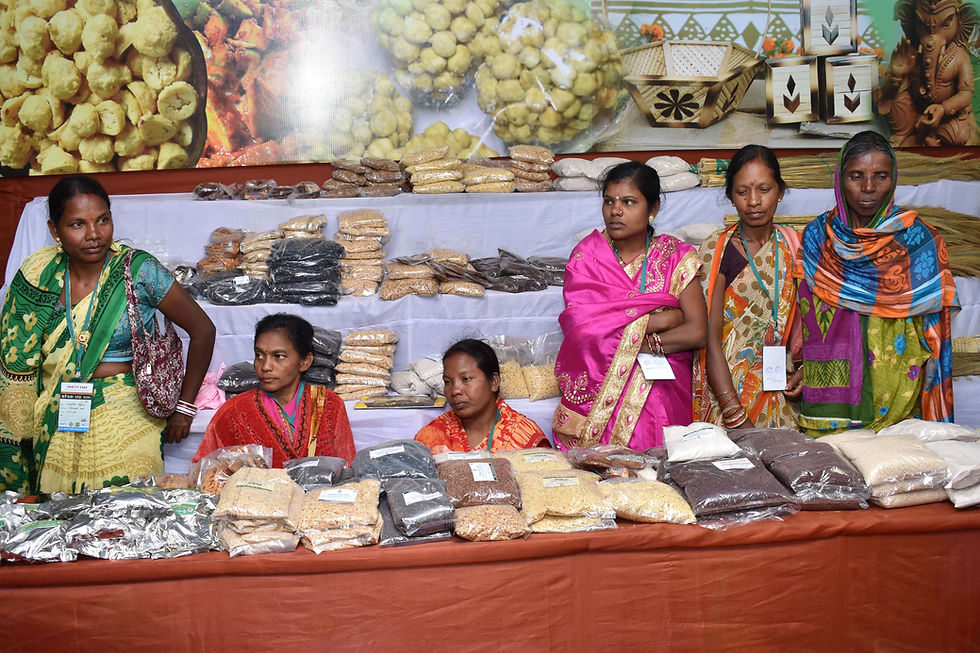
Over the years, this approach has created much more than plantations or physical assets. It has strengthened community institutions and local capacities, supported sustainable NTFP management and alternative livelihood options, and exposed VSSs to planning, financial and asset management, value addition, government programmes and markets. These may be less visible than a restored forest or a newly created asset, but they are equally important. Whether physical assets continue to generate value ultimately depends on the institutions and people who manage them after the project has concluded.
With OFSDP II scheduled to conclude in March 2027, the challenge is now shifting from creating and strengthening to sustaining and transferring. The remaining months are therefore not merely a countdown to closure. They provide a critical transition period in which the project must progressively step back while community institutions step forward, with the Forest Department continuing to facilitate and support them.
Passing the Baton: The Transition Must Begin Before Closure
I have increasingly come to see this transition as passing the baton. In a relay race, the outgoing runner does not stop and hand the baton to someone standing still. For a brief but crucial period, both runners move together. The incoming runner gains momentum as the outgoing runner slows, and the transfer occurs while the race continues.
A development project needs much the same transition. If the project team performs all the important functions until its last day, a handover may exist on paper but not necessarily in practice. The remaining months provide VSSs with an opportunity to assume responsibilities and learn by doing, while the project team remains present to facilitate and address gaps. The objective is not simply to hand over the baton, but to ensure that the next runner is already moving when the baton is handed over.
Photo courtesy: Kalahandi Gram Sabha Mahasangh/idr

The baton, however, is not made up of physical assets alone. While designing the phase-out training, our discussions ranged from micro-plans, asset inventories and financial management to convergence, sustainability planning, NTFP management, value addition and market linkages. These are not merely training topics; they are the different threads that must remain connected after project support is withdrawn. An asset can be formally handed over in a day; the capacity to manage it and use it for collective benefit takes much longer to transfer.
From Doing to Enabling
This also changes the role of the project team. For years, project personnel have been expected to facilitate, solve problems and ensure that implementation moves forward. As closure approaches, effectiveness has to be understood differently. The instinct to solve every problem must increasingly give way to allowing the VSS to deliberate, decide and act for itself. A VSS becomes sustainable not when it has merely been trained to perform a function, but when it begins performing that function, encounters difficulties, finds solutions and gains the confidence to continue. Phase-out, in this sense, is not simply withdrawal of support; it is creating space for local institutions to assume ownership.
Beyond Handover: Building the Institutional Ecosystem
There is an important caution here. Community ownership should not be confused with leaving communities to manage everything on their own. VSSs operate within a larger institutional and ecological system, and forest management will continue to require technical guidance, administrative support and coordination. As the temporary project structure recedes, the relationship between the VSS and the Forest Department must therefore become stronger and more direct. The transition is not simply from project to community; it is towards a more enduring partnership between community institutions and the permanent public system.
Photo courtesy: Kalahandi Gram Sabha Mahasangh/idr

This is also where convergence becomes critical. After project withdrawal, community institutions will increasingly have to connect their needs with programmes and institutions that continue to exist. Assets may require resources for maintenance; livelihood activities may need support from other departments; and NTFP-based enterprises may require market, financial or technical linkages. Sustainability cannot mean creating a self-contained institution. It means enabling that institution to navigate the larger development ecosystem without depending on the project team to make every connection.
Closure deserves as much planning as commencement
The more I reflected on this transition, the more I felt that the phase-out deserves to be treated as a distinct stage in the life of a development project, rather than as a set of activities undertaken just before closure. We devote considerable attention to how projects enter communities: institutions are mobilised, teams recruited, plans prepared, resources allocated and monitoring systems established. Yet withdrawal rarely receives the same managerial attention.
A responsible phase-out requires its own preparation: which functions must continue, who will perform them, what capacities are still missing, how assets will be managed, and which institutional relationships must remain. The final months are therefore not simply about completing what is unfinished. They are about preparing for a future in which the development process continues even though the project does not.
Photo Courtesy: OFSDP
The Real Test of Sustainability
When I was first asked to conduct this training, I wondered why a project approaching its conclusion would invest in training its team on phase-out. I now find myself thinking almost the opposite. Perhaps every development project should prepare for its conclusion as seriously as it prepares for its beginning. Sustainability cannot be left to the final few weeks or assumed to follow automatically from successful implementation.
For OFSDP II, the real test will increasingly shift from what the project team can accomplish to what VSSs can manage without it: whether institutions remain active, assets are cared for, forests are protected, livelihoods continue to find markets, and communities can access government institutions and programmes when support is needed. Not every transition will be equally smooth, but consciously preparing for it gives sustainability a much better chance.
Having been associated with OFSDP since its first phase, I have seen the project at different points in its journey. Perhaps that is why this final stage feels particularly significant to me. For years, the question was what the project could help communities build. Now the question is whether those institutions, capacities and relationships are strong enough to carry the journey forward.
A development project, after all, is temporary by design. Its success should ultimately be judged not only by what it achieves during its lifetime, but by how much of that achievement continues after project support has been withdrawn.
And perhaps that is the real meaning of passing the baton: the project finishes its race, but the development journey does not.
#####
Acknowledgement: I gratefully acknowledge the Odisha Forestry Sector Development Society (OFSDS), Forest, Environment and Climate Change Department, Government of Odisha, and the OFSDP II team for the opportunity to engage with the project and for the experiences and insights that have informed this reflection.
*****


Hello Sunil,
You can share this experience with people working in research in this space, such as Sharad Lele at ATREE.
Warm regards
Vivek