Bharat Taxi and the Amul Moment for Urban Mobility

Niraj Kumar
22nd December, 2025
“Bharat Taxi will run like Amul does.” Some are even calling it “a taxi owners’ Uber.”
Photo Courtesy: India Today

These phrases have captured public imagination because they signal something rare in India’s platform economy. This is not just the launch of a new app. It is the arrival of a new idea. Bharat Taxi is not attempting to disrupt mobility through discounts, cashbacks, or rapid expansion. It is trying something far more unusual by placing taxi drivers at the centre of ownership and decision-making, much like Amul did for milk producers decades ago.
If this sounds radical? It is because it is. Bharat Taxi is not old wine in a new bottle. It is a deliberate attempt to redesign ride-hailing using cooperative principles that India understands, trusts, and has successfully scaled before.
Why India’s Ride-Hailing Model Is Under Strain
From Street Hails to Smartphone Apps
Over the past decade, app-based taxis have become an indispensable part of urban life in India. What began as an alternative to street hails and radio cabs has grown into a vast digital mobility ecosystem. Platform and industry data underline the scale of this shift. India has reported about 1.4 million active drivers on its platform alone. Market research indicates that online ride-hailing accounted for more than 65 per cent of India’s taxi market in 2024. On the demand side, Uber and other companies collectively handle nearly 10 million rides daily, with over 150 million Indians using ride-hailing apps each month. Digital mobility now encompasses daily commuting, airport travel, and last-mile connectivity across metropolitan areas and tier-two cities.
Many Players, One Dominant Logic
India’s ride-hailing landscape comprises global platforms, domestic aggregators, and niche players, including airport taxi operators, fleet-based radio cabs, and regional services. Despite this diversity, most platforms follow the same underlying logic. Ownership and control remain centralised. Drivers are treated as independent service providers. Revenues are driven by commissions, incentives, and pricing algorithms. With commissions of 20 to 30 per cent, often higher after incentive clawbacks, many drivers report falling take-home incomes even as they work longer hours.
Drivers and Passengers Caught in the Middle
For drivers, the strain is both financial and institutional. Complaints commonly centre on volatile incentives, sudden rule changes, and opaque algorithmic decisions that affect ride allocation, ratings, and penalties. Drivers invest in vehicles, fuel, and time, yet have little say in how platforms are governed. Repeated protests across cities reflect a deeper unease as flexible self-employment increasingly feels like precarious gig work.
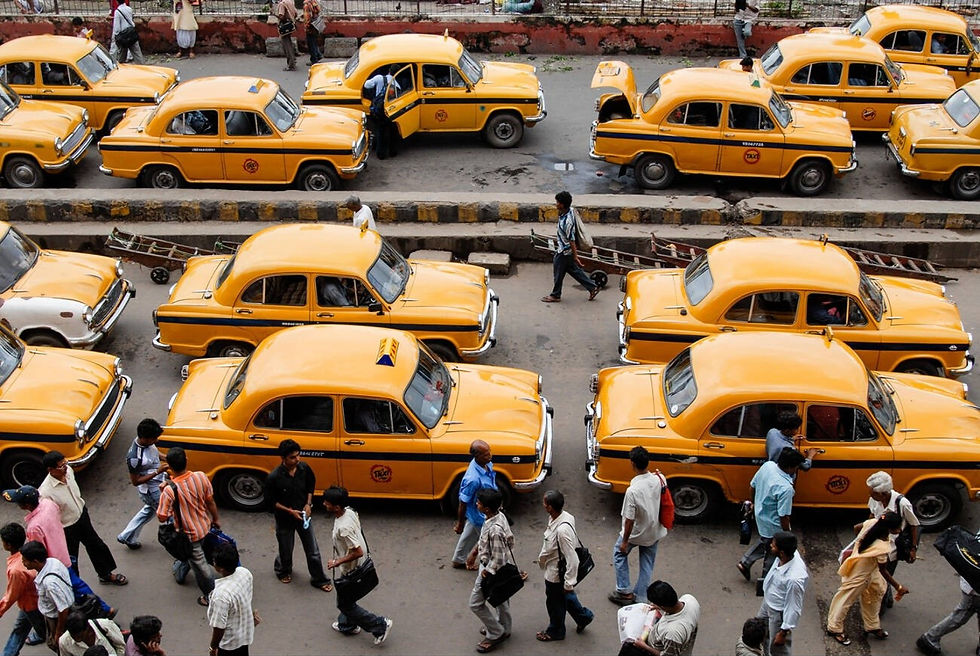
Passengers face a different paradox. Convenience has improved, but surge pricing, cancellations, inconsistent service quality, and long waits have become routine. Competition initially lowered fares, but price volatility has eroded trust. Today, dissatisfaction is visible on both sides of the market, even as platforms continue to grow rapidly. This suggests a structural weakness rather than a minor operational issue.
Photo courtesy: Alamy
A Structural Problem, Not an Operational Glitch
Despite differences in branding and scale, the prevailing ride-hailing model concentrates power at the platform level. Drivers bear the costs and risks of vehicles, fuel, and long working hours, while control over pricing and access to demand remains centralised. As growth continues alongside rising dissatisfaction, the limitations of this model have become increasingly evident. This is the space where alternative approaches, such as Bharat Taxi, begin to make sense.
What Exactly Is Bharat Taxi
Bharat Taxi is India’s first serious attempt to address these structural flaws through a cooperative platform model promoted under Sahakar Taxi Cooperative Limited. Unlike private platforms that treat drivers primarily as service providers, Bharat Taxi makes them members and co-owners of the enterprise. This shift aligns incentives, restores agency, and embeds drivers in decision-making rather than subjecting them to opaque algorithms and unilateral rule changes.
The innovation here is not limited to lower commissions. It lies in rethinking ownership and governance. By placing drivers at the centre, Bharat Taxi seeks to correct an imbalance where labour bears the risk while platforms capture the value. Supported by the policy thrust of the Ministry of Cooperative, Govt. of India, which encourages cooperatives to enter contemporary and technology-driven sectors, the initiative extends a familiar Indian idea into urban digital mobility, where it has rarely been attempted at scale.
At its core, Bharat Taxi tests a simple but powerful proposition. When those who generate value also own the platform, pricing becomes more transparent, earnings more stable, and trust more durable.
How the Cooperative Model Changes the Rules
In a cooperative structure, drivers collectively own the platform, participate in governance, and benefit directly from any surplus generated. Instead of paying high commissions, drivers typically contribute a modest membership or service fee, allowing them to retain a larger share of each fare. Pricing is designed to be predictable and transparent, with a conscious effort to limit extreme surge pricing. While this may temper short-term revenue maximisation, it strengthens trust among drivers and passengers alike. Decisions on rules, charges, and operations are intended to be collective rather than unilateral.

This logic mirrors the cooperative principle that powered Amul. When producers own the system, exploitation reduces, and long-term sustainability improves.
Why the Amul Comparison Matters
Invoking Amul is not nostalgia. It serves as a reminder that cooperatives can compete with and even outperform private corporations when governance is professional and incentives are properly aligned. By placing farmers at the centre, Amul transformed a fragmented dairy sector into a globally recognised institution.
Bharat Taxi aspires to apply the same principle to urban mobility. The comparison resonates because it reframes drivers not as gig workers but as economic stakeholders. It also challenges the assumption that digital platforms must be extractive in order to be efficient.
Why Bharat Taxi Could Work
Several factors work in Bharat Taxi’s favour. Driver motivation and loyalty are likely to improve when earnings rise, and dignity is restored through ownership. The cooperative idea enjoys deep cultural legitimacy in India through credit societies, dairy cooperatives, and producer organisations. Policy support and integration with the national digital infrastructure linked to initiatives, such as providing institutional backing that many grassroots platforms lack.
Even a modest share of urban markets could influence how platform work is imagined and regulated in India.
Where the Real Test Lies
The road ahead will not be without challenges. Ride-hailing is technology-intensive and scale-dependent. Passengers expect reliable apps, accurate maps, seamless payment processing, and prompt response times. Cooperative intent must therefore be matched with strong technical execution. Governance will be equally critical. Cooperatives can falter if decision-making becomes slow or politicised. Professional management, clear accountability, and financial discipline will determine long-term viability. Sustaining operations with low commissions will require careful cost management and steady planning.
Photo Courtesy: Ananya Dwivedi

Why This Matters Beyond Taxis
Bharat Taxi matters beyond urban transport. It is a live experiment in platform cooperativism, a model widely discussed but rarely implemented at scale. Success here could inspire cooperative platforms in logistics, delivery services, and agricultural marketing. For students of management and public policy, it offers a real-time case in alternative business models. For policymakers, it provides insights into reimagining cooperatives for the digital age. For society, it raises a deeper question about whether technology-driven growth can also be fair and inclusive.
A Platform and a Possibility
Bharat Taxi may or may not dethrone existing ride-hailing giants, and that is not the most important measure of success. Its real contribution lies in challenging the belief that platforms must prioritise capital over labour. By borrowing cooperative wisdom that once transformed India’s dairy sector, Bharat Taxi invites us to imagine a future where drivers are not merely users of an algorithm but owners of the journey itself. Whether it becomes the Amul of taxi services or not, it has already achieved something rare by starting a serious conversation about ownership, dignity, and the future of work in India’s platform economy.
*****


Comments